

Why a Balinese Entrance Is More Than a Door
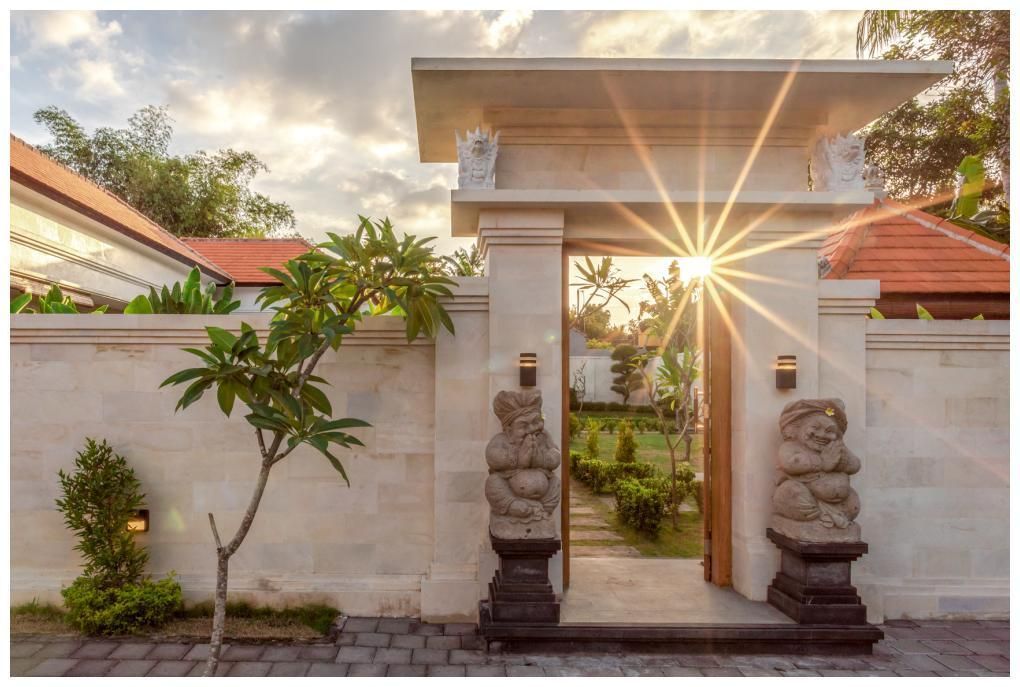
The Architecture of Arrival: Why a Balinese Entrance Is More Than a Door
There is a particular moment that happens whenever you arrive somewhere in Bali, and it often happens before you have even seen the room, the pool, the beach, or the view. It happens when you pass through an entrance. You may not consciously think about it, but the feeling of entering a Balinese home, villa, temple, boutique hotel, or traditional compound can be remarkably different from entering an ordinary building. The entrance is rarely treated as a simple opening in a wall. Instead, it can become a small architectural experience of its own: a framed view, a transition between public and private space, a change in texture, a shift in light, and sometimes a quiet reminder that you are entering somewhere with its own identity. This is one of the reasons Balinese architecture is so recognizable around the world. Visitors often remember dramatic temple gates, carved stone walls, terracotta roofs, tropical gardens, and ornamental details, but what makes these elements powerful is not simply how they look individually. It is the way they organize the experience of moving from one space into another. Indonesia Travel describes the traditional angkul-angkul as an important element of Balinese architecture, functioning as a primary gate into the courtyard of a home or temple while also carrying aesthetic and philosophical meaning. In other words, an entrance can communicate something before anyone says a word. It can suggest welcome, privacy, protection, transition, and hospitality at the same time. For travelers arriving in Bali, this architectural language can be one of the first subtle clues that they are experiencing a culture where space is not always treated simply as something functional. A wall is not merely a wall. A courtyard is not simply empty space. A gate is not necessarily just a place to pass through. The arrangement of these elements can influence how a person feels before they even understand why. Imagine walking along a busy Canggu street filled with scooters, cafés, shops, signs, traffic, and people. Then you notice a traditional-style gateway surrounded by plants. You step through it and suddenly the atmosphere changes. The sound of the road becomes softer. The light changes. The path becomes narrower. Greenery appears. The building itself may still be only a few meters away, but psychologically you have already arrived. This is the fascinating idea behind the architecture of arrival: the experience of a place begins before the place itself is revealed. In contemporary hospitality, this principle remains extremely relevant. Hotels and villas often invest heavily in the first impression because guests begin forming opinions within moments of arrival. But Bali offers a much older architectural vocabulary for creating that feeling. Traditional compounds often use sequences of spaces, walls, gateways, gardens, and courtyards to create a gradual transition rather than presenting everything immediately. Research on traditional Balinese houses notes that the angkul-angkul serves as an entrance toward the central courtyard, while the aling-aling, a small wall positioned behind the gate, can protect privacy by preventing a direct view into the interior. This is a fascinating concept for modern travelers because it demonstrates that privacy and hospitality do not have to be opposites. A space can welcome you while still maintaining a sense of separation. You can be invited inside without seeing everything at once. There can be anticipation. There can be a pause. There can be a moment between the outside world and the inside world. Perhaps this is one reason Balinese architecture often feels calm even when its ornamentation is elaborate. The visual richness is balanced by the way spaces are layered. You do not always see the whole composition immediately. Instead, you encounter it in stages. A gate frames a courtyard. A wall conceals a garden. A path leads around a corner. A doorway reveals another space. A plant partially blocks a view. Shadows fall across carved stone. The architecture asks you to move rather than simply look. And movement is exactly what makes arrival feel like an experience. This idea can be especially meaningful in Canggu, where modern tourism and traditional Balinese environments increasingly exist side by side. The neighborhood has experienced major spatial transformation as tourism, accommodation, cafés, and other businesses have expanded, changing what was once a predominantly agricultural and village environment. Academic research describes Canggu's transformation from a fishing and farming village toward an urban-characterized tourism area, while more recent research discusses how rapid tourism development has affected land use, public space, local livelihoods, traffic, and community perceptions. Against this changing landscape, architectural details can become particularly important. A traditional gateway, a courtyard, a planted entrance, or a carefully framed view can provide continuity even as the surrounding environment changes. For travelers, noticing these details can create a deeper appreciation of Bali—not simply as a beautiful destination, but as a place where architecture has long been connected to ideas about community, nature, privacy, spirituality, and the relationship between people and their surroundings.
The Gate as a Threshold: The Few Steps Between One World and Another
The word “entrance” sounds simple, but in Balinese architecture the idea of entering can be much richer than simply opening a door and walking inside. Traditional Balinese buildings often use gateways as markers of transition, and different types of gateways can indicate different spatial relationships. One of the most recognizable forms is the candi bentar, the split gateway consisting of two symmetrical halves with an opening between them. Another is the roofed gateway often associated with kori agung or paduraksa, which can mark a more significant transition within a compound. A recent overview from NOW! Bali explains that the candi bentar commonly marks an entrance or boundary within compounds and temples, while the kori agung functions as a more important threshold toward an inner sanctum. The distinction is important because it shows that Balinese architecture can communicate hierarchy through movement. Not every doorway means the same thing. Not every space is equally public. Not every part of a compound is intended to be entered in the same way. The architecture helps visitors understand this without requiring a written explanation. This is particularly interesting for travelers because modern buildings often attempt to make movement as effortless as possible. Automatic doors open immediately. Corridors are designed to be direct. Signs tell you exactly where to go. The experience is efficient, but sometimes efficiency removes the sense of anticipation. Traditional Balinese architecture can work differently. A wall may partially hide what lies beyond. A gate may narrow the view. A short flight of steps may require you to change your pace. A courtyard may be revealed only after passing through an entrance. These small moments create awareness. You become conscious that you are moving from one environment into another. The threshold becomes an experience rather than an inconvenience. There is also a visual reason these gateways are so memorable. Traditional materials such as brick, volcanic stone, carved wood, terracotta, and natural textures create surfaces that respond beautifully to Bali's tropical light. In the morning, stone can appear cool and dark. At midday, carvings create sharp shadows. In the late afternoon, warm light can emphasize the texture of brick and wood. After rain, stone surfaces become darker and more dramatic. Plants surrounding the gateway change the composition again. This means the same entrance can look different throughout the day. A gateway photographed at 8 AM may feel fresh and open, while the same structure at 5 PM may feel warm and atmospheric. This makes entrances particularly useful for hotel photography because they communicate a sense of place without requiring a wide landscape. A carefully photographed doorway can immediately tell the viewer that the property is connected to Bali. More importantly, it can communicate a mood. A lush entrance suggests tranquility. A carved stone gate suggests heritage. A minimalist tropical entrance can suggest modern Bali. A courtyard framed by greenery can suggest privacy and escape. The architectural threshold therefore becomes part of storytelling. It tells guests what kind of experience may exist beyond it. This concept also connects naturally with hospitality. When someone arrives at a hotel, they are not simply checking in. They are transitioning from one environment into another. They may have spent hours traveling through airports, sitting in traffic, carrying luggage, checking maps, answering messages, and managing logistics. The entrance is the first opportunity to tell them that the journey has changed. The road is behind them. The stay begins here. This is why thoughtful arrival design can have such a strong emotional effect. It does not necessarily need to be extravagant. Sometimes a simple pathway, a planted wall, warm lighting, natural stone, or a carefully framed doorway is enough. The important element is the transition. Bali's traditional architecture provides an extraordinary example of how this can be achieved. The architecture does not simply say, “Welcome.” It creates a physical experience of entering.
Beyond the Gate: Courtyards, Greenery and the Art of Not Showing Everything at Once
One of the most beautiful characteristics of traditional Balinese spatial design is the importance of what lies beyond the entrance. A gateway can be impressive, but the real experience often begins after passing through it. Instead of immediately revealing an entire building, a Balinese entrance may lead toward a courtyard, garden, pavilion, pathway, or another partially concealed space. This creates a sequence of discovery. The visitor sees one part first and gradually understands the larger environment. Traditional Balinese house compounds are organized around multiple structures and open spaces rather than one single enclosed building, and the central courtyard or natah plays an important role in this arrangement. Research on traditional Balinese houses describes the relationship between the entrance, the aling-aling, the courtyard, and surrounding spaces as part of a larger spatial system rather than a collection of isolated architectural features. This approach has an interesting lesson for modern hospitality design: privacy can be created through sequence rather than isolation. A guest does not necessarily need a completely closed environment to feel private. A wall, planting, change in direction, or carefully positioned entrance can provide separation while still allowing light, air, greenery, and openness. This is particularly relevant in tropical environments such as Bali, where indoor and outdoor spaces naturally interact. A courtyard can provide shade while allowing ventilation. Plants can create visual privacy while softening hard architectural surfaces. A pathway can guide movement without requiring signs everywhere. The result can feel relaxed because the architecture works with the environment rather than fighting it. This is also where Bali's famous relationship with greenery becomes more meaningful. Plants are not always simply decorative additions placed around a building after construction. They can become part of the spatial experience. A frangipani tree near an entrance, palms framing a pathway, vines climbing a wall, or tropical foliage partially hiding a building can change how the architecture is perceived. Greenery can make a boundary feel softer. It can reduce visual noise. It can create shade and provide a sense of depth. For photographers, this creates endless opportunities because the entrance is never completely static. Leaves move in the wind. Sunlight passes through them. Shadows shift across stone. Flowers appear and disappear with the seasons. Rain changes the color of surfaces. These details make architecture feel alive. This philosophy of revealing rather than immediately displaying everything can also be applied to modern hotel design. Guests increasingly appreciate spaces that offer moments of discovery. A property does not have to show its pool immediately from the entrance. A garden path can create anticipation. A staircase can reveal a view gradually. A doorway can frame the landscape rather than expose it all at once. Even a small hotel can use this principle. The arrival area can lead toward a courtyard, which opens toward a pool, while rooms remain slightly separated. The guest experiences the property in stages. This can make a relatively compact space feel larger because the eye is encouraged to move. For a property like Aviator Bali, located in an area where contemporary accommodation exists alongside the rapidly evolving Canggu landscape, this idea is especially useful. A modern property does not need to imitate a traditional Balinese compound completely in order to feel connected to its surroundings. It can instead borrow the underlying principles: create transitions, use greenery, respect privacy, frame views, allow natural light to shape spaces, and give guests a sense of gradual discovery. This is where cultural inspiration becomes more meaningful than simply adding decorative Balinese ornaments. It is not about putting carvings everywhere. It is about understanding why certain spatial decisions feel comfortable and memorable. A beautiful gate is wonderful, but a beautiful gate that leads to a thoughtful sequence of spaces is even more powerful. The architecture becomes a journey.
What Modern Bali Can Learn From the Traditional Idea of Arrival
Bali is changing rapidly, and nowhere is this more visible than in the southern parts of the island. Canggu has become one of the clearest examples of this transformation. Academic research has documented the shift from agricultural and village-oriented spaces toward tourism-related development, while recent studies have raised questions about land conversion, public space, environmental sustainability, and the social effects of rapid tourism growth. Another 2026 study focusing on North Kuta highlights the tension between economic benefits from tourism and the loss or transformation of agricultural land and traditional livelihoods. These changes make architecture more than a question of aesthetics. When a destination develops quickly, the visual identity of the place can change with it. Buildings become taller, roads become busier, agricultural landscapes become fragmented, and new businesses introduce architectural styles from around the world. In this environment, retaining meaningful elements of local design can help preserve a sense of place. But preservation does not necessarily mean freezing Bali in the past. Modern buildings can still be contemporary, comfortable, efficient, and international while respecting local architectural ideas. The important question is not whether a building looks “traditional enough.” The more interesting question is whether it understands the principles behind the tradition. Does the building respect the relationship between indoor and outdoor space? Does it create meaningful transitions? Does it provide privacy without completely disconnecting guests from nature? Does it use materials and landscaping thoughtfully? Does it acknowledge that it is located in Bali rather than somewhere else in the world? These questions can produce more authentic architecture than simply copying decorative elements. For travelers, this matters because accommodation increasingly becomes part of the destination experience. A hotel room is not experienced in isolation. Guests notice the entrance, the pathway, the surrounding streets, the plants, the light, the materials, the views, and the way the property connects with its neighborhood. They notice whether a place feels generic or whether it has a personality connected to where it stands. This is particularly important in Canggu, where travelers can find an enormous variety of architectural styles within a relatively small area. Some properties are minimalist. Others are industrial. Some emphasize tropical gardens. Others use strong Balinese references. Some prioritize open-air living, while others create more enclosed private spaces. None of these approaches is automatically better, but the most memorable properties often understand the relationship between design and experience. At Aviator Bali, the idea of “Fly Your Life” can be interpreted through this lens: a stay does not have to imitate a traditional Balinese house to allow guests to feel connected to Bali. It can provide a contemporary base while encouraging guests to notice the environment around them. The property can be a starting point for discovering the streets, cafés, beaches, rice fields, temples, local businesses, and changing neighborhoods of Canggu. In this sense, architecture becomes a bridge rather than a boundary. It gives guests comfort while keeping them connected to the destination. Perhaps this is the most important lesson hidden in the traditional Balinese entrance. A doorway does not only separate inside from outside. It connects two experiences. It tells you that you are leaving one environment and entering another. It creates a pause before discovery. And in a destination changing as quickly as Bali, those moments of transition may become increasingly valuable. Travelers may not remember the exact dimensions of a wall or the material used for a pathway, but they remember how a place made them feel when they arrived. They remember walking through a beautiful gate. They remember the garden beyond it. They remember the first glimpse of a pool between tropical plants. They remember the quietness after leaving the road behind. They remember the feeling that, for a moment, they had entered somewhere different. That is the real power of the architecture of arrival. It does not simply decorate a destination. It prepares you to experience it.